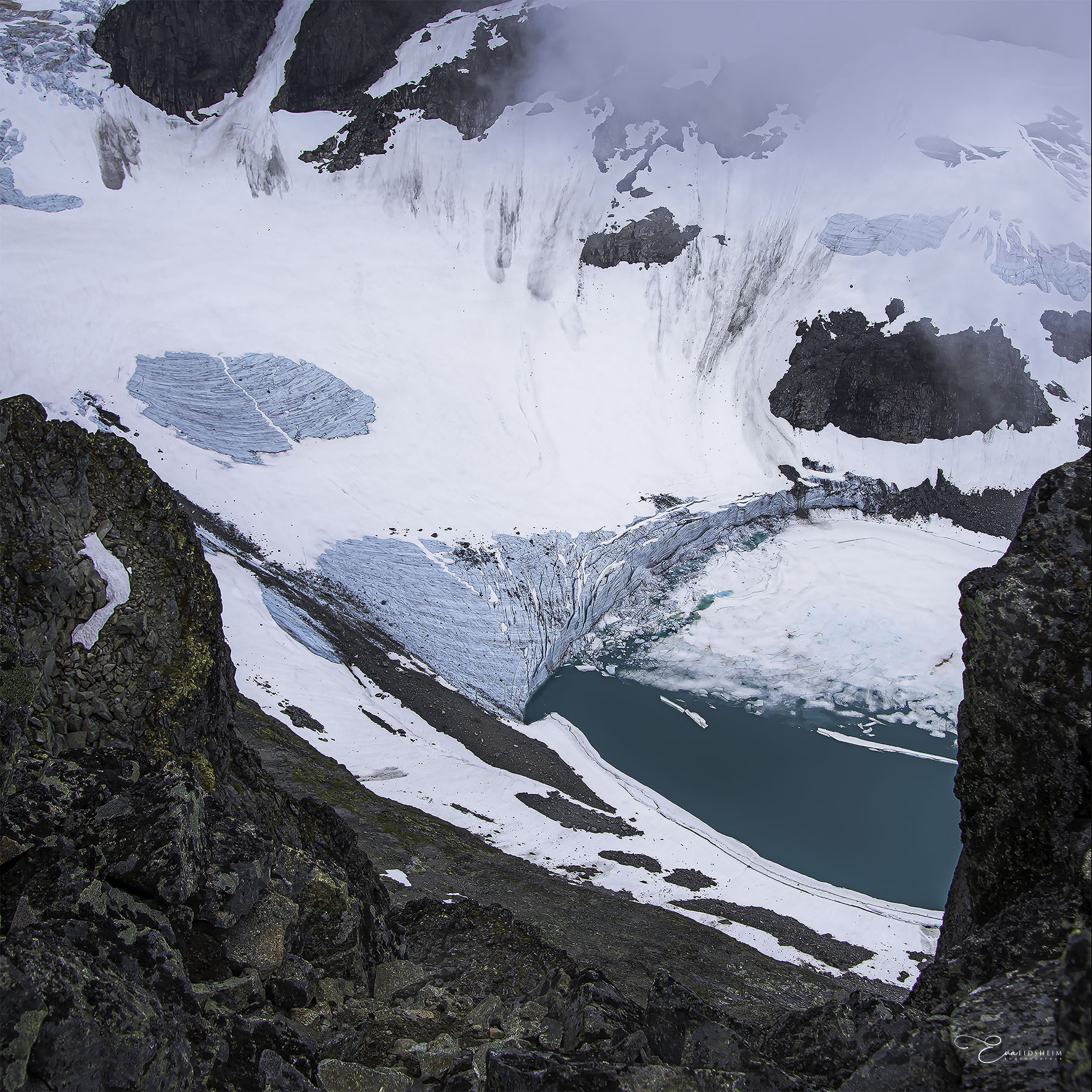
Berdalsbreen Glacier in Hurrungane, Jotunheimen
The landscape surrounding the Berdalsbreen glacier in Hurrungane, the westernmost and most alpine part of Jotunheimen National Park, is characterized by profound geological contrasts. When photographing near the glacier-fed lake Berdalsvatnet, I was particularly drawn to the intense blue light glowing from within the glacier ice itself.
While the dark, towering rock walls of hard gabbro surrounding the glacier are slowly shaped and broken down by frost weathering over thousands of years, the glacier moves and changes much faster from season to season. Nature up here, accessed from the scenic Tindevegen mountain road, never stands still. This means the conditions, the crevasses, and the alpine light shift from minute to minute while standing there with the camera.
The unseen changes and the melting permafrost
Data spanning three decades, collected from Svalbard in the north to Spain’s Sierra Nevada in the south, confirms a clear trend: permafrost throughout European mountain ranges is warming and disappearing. This degradation is occurring much faster than previously anticipated, matching the rapid thaw rates observed in Arctic regions like northern Siberia and Canada.
According to permafrost expert Ketil Isaksen, a senior researcher at the Norwegian Meteorological Institute, these frozen layers have remained stable for thousands of years. However, large sections are now thawing in just ten to twenty years.
Beyond the moving ice, this significant shift is highly visible in the steep mountains surrounding Berdalsbreen. Deep within the highest peaks of Jotunheimen, sections of the permafrost have remained frozen and intact since the last ice age—for more than 115,000 years. However, due to recent global warming, this ancient frozen ground is thawing at a rapid pace.
While natural cycles previously took thousands of years to establish stable temperatures, recent climate change has altered the mountain environment in just a few decades. In Jotunheimen, this warming is most evident below 1,600 meters, where the permafrost is disappearing. When documenting this alpine landscape with a camera today, there is a profound awareness that even the hardest rock walls are changing faster than ever before.
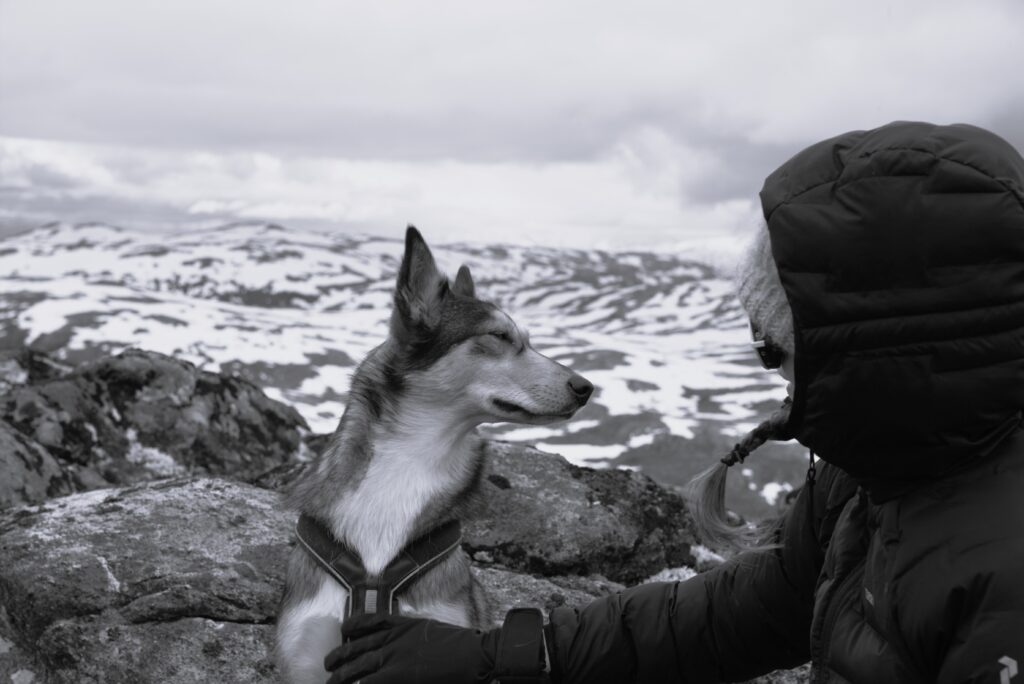
Heading toward the summit of Store Soleibotntind
Capturing a moment during the final, steep ridge climb toward the summit of Store Soleibotntind—as a hiker pauses to pet a husky against a backdrop of snowy peaks—the raw energy of Hurrungane is undeniable.
However, documenting landscapes in Jotunheimen brings a deep sense of responsibility. According to the UN Intergovernmental Science-Policy Platform on Biodiversity and Ecosystem Services (IPBES), human activity has significantly altered 75 percent of the Earth’s land surface, triggering a global biodiversity crisis.
For me, capturing these areas with a camera goes hand in hand with preserving them exactly as they are. Practicing sustainable hiking and leaving no trace ensures that the ancient rocks, pristine waters, and wild silence remain undisturbed for the future. Witnessing these rapidly changing environments (her kan vi bruke landscapes igjen hvis du vil) is a powerful reminder to respect and care for the wild nature around us.